How Narrowing Your Focus Grows Your Business
Let me ask you something. If I said “John Wayne,” what pops into your head? Westerns, right? Sure, he made war pictures — but when you hear his name, you see a cowboy. That’s his brand. That’s his one thing.
Now I say “Tom Brady.” You don’t even hesitate. Greatest quarterback of all time. The GOAT. Patriots. Rings. You know exactly what he does and exactly how well he does it.
Okay. Now I say your name.
What do people think of? Is there a one-thing that comes to mind — a specific problem you solve, a specific type of client you serve — or does it get a little fuzzy?
If it’s fuzzy, this post is for you.
The 80/20 Rule Isn’t a Theory. It’s Your Competition.
Twenty percent of the people in any industry are doing eighty percent of the business. Read that again. In your field — whatever you sell, whatever service you offer — one in five people is capturing nearly all of the real revenue.
Here’s the part most people get wrong: they think the difference between that top twenty percent and everyone else is talent, or connections, or luck. It’s not.
It’s focus.
The people at the top of their field didn’t get there by chasing every opportunity and serving every type of client. They got there by doing one thing exceptionally well — and becoming the person that everyone else points to when that thing comes up in conversation.
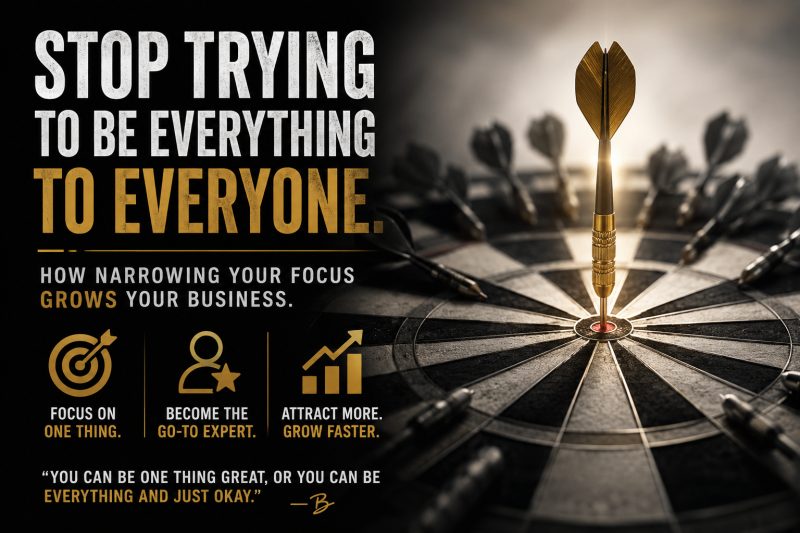
“You can be one thing great, or you can be everything and just okay.” — B
Meet the Spaz — And What He Got Right
Early in my insurance career at Aflac, I was handed a phone book and told to start dialing. Cold calling is miserable — you dread the negativity, you dread the nos — but somewhere in all of that grinding, I got to watch one of the best lessons in focus I’ve ever seen play out right in front of me.
There was a guy in our group we called the Spaz. And the Spaz was exceptional at exactly one thing: nursing homes. He knew the staff, the managers, which products those employees needed most. He sold disability coverage, cancer plans, and accident coverage — three or four products, not the whole catalog — and he walked into one nursing home, nailed it, got referred to another, and built an entire book of business by going deep into one world.
I looked at what he was doing and thought: I can do that. So I went after group homes — smaller residential care facilities in neighborhoods. Same products. Same approach. The problem was scale. The Spaz walked into one building and saw thirty employees across three shifts. I drove to multiple locations and saw six people per house. His numbers were great. Mine were okay.
And here’s where I made the mistake I’d keep making for years: instead of seeing the lesson — go deeper, find bigger concentrations of your target customer, specialize harder — I looked at the guy selling health and life insurance to my same accounts and thought, why can’t I do that too? Why can’t I be the one-stop shop?
“If you try to be everything to everyone, you end up being nothing to no one.” — Seth Godin
That thinking was my pattern for years. And it cost me every single time.
When I Finally Got It Right: The HSA Guy
It wasn’t until I became known as “the HSA guy” that I actually felt what focus could do.
I believed in Health Savings Account plans so much that I became great at selling them. I figured out how to package an HSA with dental, short-term disability, and supplemental coverage in a way that let small business owners give their employees more — at a lower cost. I learned how to walk into a business and teach the employees how to actually use the plan.
And something happened. Word spread. One employee told another. One business owner sent me to their colleague. Insurance carriers wanted to talk to me because I was moving more HSA volume than anyone in my market. For the first time in my career, people knew me as something specific. Not a health insurance agent. Not a one-stop shop.
The HSA guy.
“When you own one thing, you own the room. When you own everything, you own nothing.” — B
Keith Stonehouse Owns a Room Without Even Being In It
In metro Detroit, Keith Stonehouse is the undisputed king of title insurance. His license plate says it all: Mr. Title. Park his car anywhere in town and people know exactly what he does. He knows plenty about real estate — but the one thing he’s known for, the one thing he owns, is title insurance. And because he owns it, he dominates it.
That’s what being focused does. It makes your name synonymous with a solution. It means that when your ideal client has a problem — that problem — your name is the first one out of someone’s mouth.
Keith Stonehouse didn’t get there by trying to be everything to everyone. He picked his lane and drove it harder than anyone else in the market.
What This Means for You
You can still do the other things. Nobody is telling you to turn away business or throw out your existing clients. But there needs to be one thing — your golden ring — that you pursue with real focus and intention, even while you’re handling the day-to-day work that keeps the lights on.
When you’re not the specialist, price becomes the only conversation. And a race to the bottom on price helps nobody — the next person will always claim to be cheaper. But when you own a niche? You’re not competing on price anymore. You’re competing on expertise. And expertise doesn’t have a comparison shopper.
Ask yourself the real question: What do I do best, and who do I do it for? Not in a vague, general way — specifically. The answer isn’t in the expanding. It’s in the narrowing.
“Without a niche, you’re just going to be the average Joe. Average pays average. A niche pays dividends.” — B
By the time the right people finish reading this, they’ll think of one name when their problem comes up. Make sure that name is yours.
— — —
This post is adapted from Salesperson’s Platbook by B, available now. If this resonated with you, reach out to DBG to learn how we help salespeople build a reputation around what they do best.
How Narrowing Your Focus Grows Your Business
